Few names in team sport carry the weight of the Lakers when the subject turns to winning. Across two cities and more than seven decades, the franchise has assembled 17 NBA championships, a haul matched only by the Boston Celtics in league history. The story is not one continuous run but a series of distinct dynasties, each built around a defining big man or a defining backcourt, and each separated by fallow years that make the peaks stand out all the more.
This page sets out the complete championship record: every title, every opponent, and the figures who delivered them. The through-line is remarkable. The Lakers have reached the NBA Finals 32 times, more than any other club, and turned 17 of those trips into titles.
The Minneapolis foundation (1949-1954)
Before Los Angeles, there was Minneapolis, and before the modern game there was George Mikan. The 6ft 10in center was pro basketball’s first genuine superpower, and around him the Lakers built the league’s original dynasty. They captured the 1949 title in the Basketball Association of America, then, after the merger that created the NBA, won in 1950, 1952, 1953 and 1954. Five championships in six seasons remains one of the most concentrated bursts of dominance the sport has produced.
Mikan was so influential that rule changes, including the widening of the lane, were introduced in part to blunt his impact. Alongside Jim Pollard and Vern Mikkelsen, he gave the franchise a winning identity that would survive the move west in 1960.
5titles in Minneapolis, 1949-1954The long wait and the 1972 breakthrough
The move to Los Angeles brought glamour, star power and, for a frustrating stretch, heartbreak. Through the 1960s the Lakers of Jerry West and Elgin Baylor reached the Finals again and again, only to run into Bill Russell’s Celtics. Seven Finals defeats to Boston in that era hardened the rivalry into the defining feud in the sport.
The drought ended in 1972. That team, powered by Wilt Chamberlain, West and Gail Goodrich, put together a 33-game winning streak on the way to a 69-13 regular season, then beat the New York Knicks in five games. It was the first Los Angeles championship, and it validated a decade of near misses.
Showtime: Magic, Kareem and the 1980s
The arrival of Magic Johnson in 1979 launched the most celebrated era in franchise history. Paired with Kareem Abdul-Jabbar and directed later by Pat Riley, the fast-breaking “Showtime” Lakers won five titles in the 1980s. Johnson announced himself immediately, starting Game 6 of the 1980 Finals at center in place of the injured Abdul-Jabbar and posting 42 points to close out the Philadelphia 76ers.
Further titles followed in 1982 and, crucially, in 1985, when the Lakers finally beat the Celtics in a Finals series after decades of defeats. They repeated over Boston in 1987, then went back-to-back with a seven-game win over the Detroit Pistons in 1988, becoming the first team in nearly two decades to defend the championship.
The Shaq and Kobe three-peat (2000-2002)
After a barren stretch through most of the 1990s, the Lakers reloaded around Shaquille O’Neal and a young Kobe Bryant, with Phil Jackson arriving to install the triangle offense. The result was a three-peat: victories over the Indiana Pacers in 2000, the Philadelphia 76ers in 2001 and a sweep of the New Jersey Nets in 2002. O’Neal was named Finals MVP in all three series, a level of postseason dominance in the middle few teams have ever contained.
Kobe’s second act and the Pau Gasol years
The partnership with O’Neal fractured after a 2004 Finals loss, and Bryant carried the franchise through a rebuild before a trade for Pau Gasol restored contention. The Lakers lost the 2008 Finals to Boston, then answered emphatically. They beat the Orlando Magic in 2009 and, in 2010, exacted revenge on the Celtics in a tense seven-game series, giving Bryant his fifth ring and Jackson his final title as a head coach.
LeBron, Davis and the 2020 title
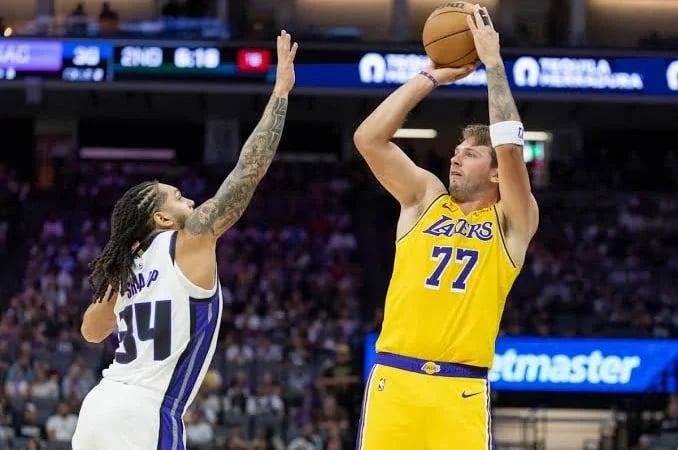
A decade later, the Lakers returned to the summit under very different circumstances. With LeBron James and Anthony Davis leading the way, they won the 2020 championship inside the isolated “bubble” at Walt Disney World, a setting created to complete the season after a lengthy suspension. The four-games-to-two win over the Miami Heat was the franchise’s 17th title and its first since 2010.
The full championship ledger
| Year | Era | Opponent | Result | Key figures |
|---|---|---|---|---|
| 1949 | Minneapolis | Washington Capitols | 4-2 | George Mikan |
| 1950 | Minneapolis | Syracuse Nationals | 4-2 | Mikan, Pollard |
| 1952 | Minneapolis | New York Knicks | 4-3 | Mikan, Mikkelsen |
| 1953 | Minneapolis | New York Knicks | 4-1 | Mikan |
| 1954 | Minneapolis | Syracuse Nationals | 4-3 | Mikan |
| 1972 | Los Angeles | New York Knicks | 4-1 | Chamberlain, West, Goodrich |
| 1980 | Showtime | Philadelphia 76ers | 4-2 | Magic Johnson, Abdul-Jabbar |
| 1982 | Showtime | Philadelphia 76ers | 4-2 | Johnson, Abdul-Jabbar |
| 1985 | Showtime | Boston Celtics | 4-2 | Abdul-Jabbar, Johnson |
| 1987 | Showtime | Boston Celtics | 4-2 | Johnson, Worthy |
| 1988 | Showtime | Detroit Pistons | 4-3 | Johnson, Worthy |
| 2000 | Shaq-Kobe | Indiana Pacers | 4-2 | O’Neal, Bryant |
| 2001 | Shaq-Kobe | Philadelphia 76ers | 4-1 | O’Neal, Bryant |
| 2002 | Shaq-Kobe | New Jersey Nets | 4-0 | O’Neal, Bryant |
| 2009 | Kobe-Gasol | Orlando Magic | 4-1 | Bryant, Gasol |
| 2010 | Kobe-Gasol | Boston Celtics | 4-3 | Bryant, Gasol |
| 2020 | LeBron-Davis | Miami Heat | 4-2 | James, Davis |
The Celtics measuring stick
No account of Lakers championships is complete without Boston. The two clubs have met a record 12 times in the Finals, and for most of that history the Celtics held the upper hand, winning nine of those series to the Lakers’ three (1985, 1987 and 2010). For decades the franchises were locked together atop the all-time list at 17 titles each, before Boston moved ahead with an 18th championship in 2024. That rivalry, more than any statistic, frames how the Lakers’ haul is judged.
What the record tells us
The Lakers’ 17 championships are best understood as proof of institutional continuity rather than a single dynasty. The franchise has never gone more than a couple of decades without contending, and it has repeatedly attracted or developed the era-defining player needed to win. That pattern, from Mikan to James, is the real story behind the trophy count. The banners hang from different cities and different generations, but they describe one persistent trait: an organization built to keep coming back.