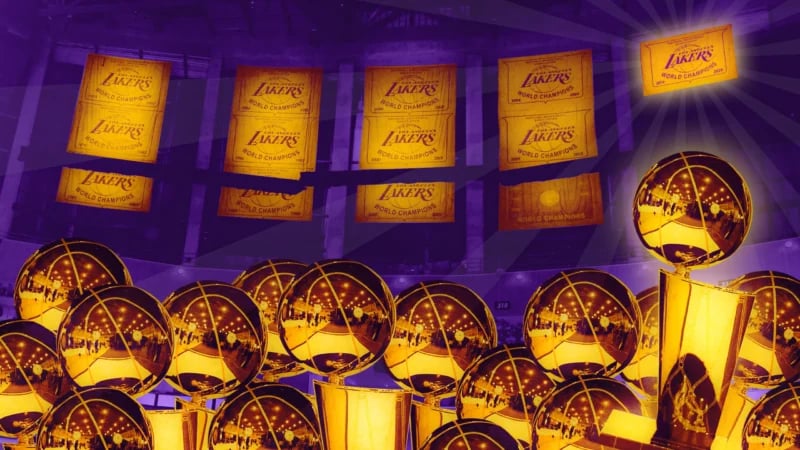
Few phrases carry as much weight in professional basketball as “Lakers titles.” The franchise has won 17 NBA championships, a haul built across two cities, seven decades and several distinct dynasties. That total sits level with, and for most of history ahead of, every rival except the Boston Celtics, whose 18th banner in 2024 nudged them one clear at the top. What follows is a complete and durable record of how the Lakers assembled those 17 championships, who won them, and what the numbers say about the club’s place in the sport.
The count breaks down cleanly by era and location: five championships came in Minneapolis between 1949 and 1954, and 12 have come in Los Angeles since the move west in 1960. No franchise has reached the NBA Finals more often. The Lakers have played for the title 32 times, winning 17 and losing 15, and many of those defeats came against the Celtics during the long green-and-gold rivalry that shaped the league’s early decades.
The Minneapolis Origins: Mikan’s Five
The first Lakers dynasty had nothing to do with Southern California. Based in Minneapolis and anchored by George Mikan, the sport’s first dominant big man, the Lakers won the Basketball Association of America title in 1949, then followed it with NBA championships in 1950, 1952, 1953 and 1954. The BAA and NBA lineages are treated as one continuous league, which is why the 1949 crown counts toward the franchise total.
Coached by John Kundla, those Minneapolis teams were the template for everything that came after: a towering center as the offensive hub, disciplined half-court play, and a habit of winning when it mattered most. Mikan was so central to the game that his presence helped force rule changes, including the widening of the free-throw lane. By the time the club relocated to Los Angeles in 1960, it already owned five championships and a reputation as basketball’s model organization.
5Titles won in Minneapolis (1949-1954)West, Baylor and the Long Wait
The move to Los Angeles did not immediately extend the trophy run. Through the 1960s the Lakers, led by Jerry West and Elgin Baylor, became the league’s great runners-up, losing six Finals to Bill Russell’s Celtics between 1962 and 1969. West’s brilliance in defeat produced one of the sport’s enduring oddities: in 1969 he became the only player from a losing team to be named Finals MVP, an award introduced that very year.
The drought finally ended in 1972. With West and Wilt Chamberlain leading a roster that reeled off a record 33 consecutive wins and finished 69-13, the Lakers beat the New York Knicks in five games. It was the franchise’s first championship in Los Angeles and its sixth overall, and it validated a decade of near misses.
Showtime: The 1980s Dynasty
The arrival of Magic Johnson in 1979 launched the most glamorous era in club history. Paired with Kareem Abdul-Jabbar and his unstoppable skyhook, and later powered by James Worthy, the “Showtime” Lakers turned fast-break basketball into spectacle and won five championships in the decade: 1980, 1982, 1985, 1987 and 1988.
The signature moments came in bunches. As a 20-year-old rookie in 1980, Johnson started at center in the clinching Game 6 against the Philadelphia 76ers, with Abdul-Jabbar sidelined by injury, and produced 42 points to seal the title. The 1985 win over Boston was especially sweet, the first time the Lakers had beaten the Celtics in a Finals after eight previous losses. Pat Riley coached four of those five championships, and his 1988 side, which beat the Detroit Pistons in seven games, became the first team in nearly two decades to repeat as champions.
The Shaq and Kobe Three-Peat
After a lean 1990s, the pairing of Shaquille O’Neal and a young Kobe Bryant, guided by coach Phil Jackson and his triangle offense, restored the dynasty. The Lakers won three straight championships from 2000 to 2002, beating the Indiana Pacers, the 76ers and the New Jersey Nets in turn. O’Neal, at the peak of his powers, was named Finals MVP all three times, a run of individual dominance rarely matched.
Bryant carried the torch into the next decade. With Pau Gasol arriving to give him a skilled frontcourt partner, the Lakers won back-to-back titles in 2009 and 2010, Bryant earning Finals MVP honors both years. The 2010 championship, a grinding seven-game win over Boston, avenged a bitter defeat to the same Celtics in 2008 and gave Bryant his fifth ring, tying him with the great Lakers who came before.
The Bubble Banner: 2020
The most recent championship arrived under extraordinary circumstances. The 2019-20 season was suspended and then restarted inside a quarantined campus at Walt Disney World in Florida, and it was there that LeBron James and Anthony Davis led the Lakers past the Miami Heat in six games. James was named Finals MVP, having now won the award with three different franchises. The title carried added emotional weight, coming in the year of Bryant’s death, and it lifted the Lakers to 17 championships, briefly level with Boston at the top of the all-time list.
The Full Ledger
| Year | Opponent | Series | Key figure |
|---|---|---|---|
| 1949 | Washington Capitols | 4-2 | George Mikan |
| 1950 | Syracuse Nationals | 4-2 | George Mikan |
| 1952 | New York Knicks | 4-3 | George Mikan |
| 1953 | New York Knicks | 4-1 | George Mikan |
| 1954 | Syracuse Nationals | 4-3 | George Mikan |
| 1972 | New York Knicks | 4-1 | Wilt Chamberlain |
| 1980 | Philadelphia 76ers | 4-2 | Magic Johnson |
| 1982 | Philadelphia 76ers | 4-2 | Magic Johnson |
| 1985 | Boston Celtics | 4-2 | Kareem Abdul-Jabbar |
| 1987 | Boston Celtics | 4-2 | Magic Johnson |
| 1988 | Detroit Pistons | 4-3 | James Worthy |
| 2000 | Indiana Pacers | 4-2 | Shaquille O’Neal |
| 2001 | Philadelphia 76ers | 4-1 | Shaquille O’Neal |
| 2002 | New Jersey Nets | 4-0 | Shaquille O’Neal |
| 2009 | Orlando Magic | 4-1 | Kobe Bryant |
| 2010 | Boston Celtics | 4-3 | Kobe Bryant |
| 2020 | Miami Heat | 4-2 | LeBron James |
What the Numbers Reveal
The distribution of the 17 titles tells a story of sustained excellence rather than a single golden age. The Lakers won championships in eight different decades’ worth of eras, from Mikan through James, a longevity no other franchise can quite claim. Their players have collected the Finals MVP award more often than any other club’s, led by O’Neal and Johnson with three apiece and Bryant with two.
Coaching has been every bit as decorated. Phil Jackson won five titles on the Lakers bench, matching Kundla’s Minneapolis total, while Riley added four during the Showtime years. Between them, three coaching regimes account for 14 of the 17 banners.
The Celtics moved ahead 18-17 in 2024, reframing a rivalry the two clubs have shared for generations. Yet the Lakers retain the record for Finals appearances and remain the benchmark against which championship pedigree in the NBA is measured. Seventeen banners, five in Minneapolis and 12 in Los Angeles, are the durable proof of it.