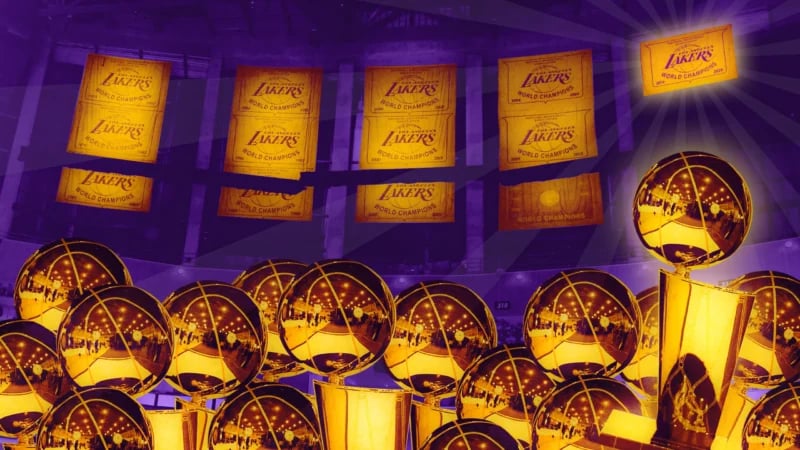
Count the banners hanging in the Lakers’ rafters and you reach 17, a total surpassed by only one club in NBA history. Stretch the accounting across the two cities the franchise has called home, Minneapolis and Los Angeles, and the number splits into five distinct waves of success rather than one continuous reign. Each wave was built around a defining talent, separated from the next by a stretch of ordinary years. That rhythm of climb, plateau and rebuild is the real story of the Lakers’ record, and it is what this page sets out to document: the titles themselves, who won them, and how the eras hand off to one another.
Reading the trophy count
The headline figure is 17, but two supporting numbers give it shape. The first is 32, the franchise’s total Finals appearances, which stands as the most of any team. The gap between reaching the final round and winning it matters here: the Lakers have lost the Finals 15 times, more defeats than most contenders ever accumulate, yet they kept returning to the stage often enough to convert on a historic scale. The second number is the split by city. Five championships belong to Minnesota, twelve to California, and the two totals are separated by a franchise relocation that reset the story almost entirely.
32NBA Finals appearances, the most of any franchiseThe Minneapolis foundation
The franchise was born in the Upper Midwest, not on the coast. The Minneapolis Lakers won the 1949 title in the Basketball Association of America, then, once the BAA and the National Basketball League merged into the NBA, added crowns in 1950, 1952, 1953 and 1954. Five championships in six seasons is a strike rate almost no franchise has equalled since.
The engine of that run was George Mikan, the first genuinely dominant big man in the professional game. Bespectacled and physically overwhelming, Mikan forced opponents to redesign their defenses around a single player, and the league responded to his interior control by widening the free-throw lane from six feet to twelve in 1951, a rule change still commonly traced to his influence. When his body began to give out, so did the dynasty. The club drifted, and by the start of the 1960-61 season it had moved west to become the Los Angeles Lakers.
5Titles won as the Minneapolis Lakers, 1949 to 1954Glamour, then heartbreak, then 1972
Los Angeles offered a bigger stage and, for more than a decade, a steady diet of disappointment. Through the 1960s the Lakers reached the Finals again and again behind Jerry West and Elgin Baylor, and lost nearly every time, most painfully to the Boston Celtics, who beat them in the championship round repeatedly across the decade. The city waited until 1972 for its first title, and when it finally came it arrived with force. That season the Lakers, with West orchestrating and an aging Wilt Chamberlain anchoring the middle, put together a 33-game winning streak that still ranks among the great records in North American team sport. They closed the year by beating the New York Knicks in the Finals, ending a run of near misses that had defined the franchise’s Los Angeles beginnings.
Showtime and the 1980s
The franchise’s most celebrated identity took hold when Magic Johnson arrived as the first overall pick in 1979. Johnson’s passing and pace turned a strong roster into the fast-breaking show known as Showtime, and paired with Kareem Abdul-Jabbar he anchored five titles in a single decade: 1980, 1982, 1985, 1987 and 1988.
The opening act set the tone. As a rookie in the 1980 Finals against the Philadelphia 76ers, with Abdul-Jabbar sidelined by an ankle injury for the deciding game, Johnson lined up at center and produced 42 points across every position on the floor to close out the series, one of the most storied individual performances the Finals has seen. The 1985 title carried a different weight because it came against Boston, the first time Los Angeles had beaten the Celtics in a Finals series and a reversal of the hex that trailed the club from the 1960s. The 1987 and 1988 championships, steered by coach Pat Riley, made the Lakers the first team in nearly two decades to win back-to-back titles, delivering on the repeat Riley had publicly promised.
| Era | Years won | Titles | Defining figures |
|---|---|---|---|
| Minneapolis dynasty | 1949, 1950, 1952, 1953, 1954 | 5 | George Mikan |
| West and Chamberlain | 1972 | 1 | Jerry West, Wilt Chamberlain |
| Showtime | 1980, 1982, 1985, 1987, 1988 | 5 | Magic Johnson, Kareem Abdul-Jabbar |
| Triangle three-peat | 2000, 2001, 2002 | 3 | Shaquille O’Neal, Kobe Bryant |
| Bryant and Gasol | 2009, 2010 | 2 | Kobe Bryant, Pau Gasol |
| Bubble title | 2020 | 1 | LeBron James, Anthony Davis |
The triangle three-peat
Johnson’s retirement opened the longest title drought of the Los Angeles era, a full decade without a championship. It closed when Shaquille O’Neal and a young Kobe Bryant came together under Phil Jackson, who imported the triangle offense he had used to build a dynasty in Chicago. The result was a rare three straight titles: over the New York-based era’s rivals and beyond, the Lakers beat the Indiana Pacers in 2000, Philadelphia in 2001 and the New Jersey Nets in 2002.
O’Neal was the fulcrum of all three, named Finals MVP in each series, an unstoppable interior presence that no defense of the period could contain. Bryant, meanwhile, grew from gifted junior partner into a co-star capable of carrying stretches on his own. The relationship between the two eventually soured, and O’Neal was traded away in 2004, ending the run.
Bryant’s second act
Bryant spent the years after O’Neal’s departure answering a single question: could he win without him. The pieces fell into place when Pau Gasol arrived in a 2008 trade and Jackson returned to the bench. The Lakers won back-to-back titles in 2009 and 2010, first over the Orlando Magic and then in a taut seven-game Finals against Boston, a last chapter in the sport’s oldest rivalry that Bryant later described as the most satisfying series of his career. Those two crowns confirmed him as a champion in his own right rather than a beneficiary of O’Neal’s dominance.
The bubble and where the record rests
The franchise’s most recent championship came in circumstances no earlier team faced. When the 2019-20 season was suspended and then restarted inside a sealed campus at Walt Disney World in Florida during the coronavirus pandemic, the Lakers won the title in what became known as the bubble. LeBron James and Anthony Davis led a roster competing in empty arenas hundreds of miles from home, defeating the Miami Heat in the Finals. The result carried added emotional freight, arriving months after the death of Bryant in January 2020, whose absence shadowed the entire campaign.
That 2020 title pushed the Lakers to 17 championships, level at the time with the Boston Celtics for the most in league history. Boston has since moved a step ahead, leaving the Lakers second on the all-time list. On Finals appearances the order flips: the Lakers lead everyone with 32, well clear of Boston’s 23, a measure of how reliably the club has reached the final stage even in seasons that ended in defeat.
Set out plainly, the ledger reads five titles in Minneapolis and twelve in Los Angeles, or, viewed by dynasty, five separate championship cores plus the standalone 1972 breakthrough. Many franchises catch a single dynasty, ride it and then fade. The Lakers’ distinguishing trait is that they keep starting over successfully, which is why the total climbs across decades instead of freezing inside one. The 17 titles are not a smooth line but a sequence of steep ascents and long plateaus, and the franchise’s real skill has been less about avoiding the lean years than about finding, roughly once a generation, the singular player able to begin the next climb.