Cristiano Ronaldo won the Ballon d’Or five times, in 2008, 2013, 2014, 2016 and 2017. Set out plainly like that, the tally looks simple. The reality is a little more tangled, because the award itself was rebuilt twice during those years. It began as France Football’s journalist-decided prize, merged with FIFA’s World Player of the Year between 2010 and 2015, then split off again in 2016. Ronaldo won under all three versions, which is part of what makes his record worth reading closely rather than just counting.
What follows is the settled account, year by year, using the point totals and vote shares that France Football and FIFA published at the time. One detail recurs in every entry: Lionel Messi finished second to Ronaldo on all five occasions, a symmetry that sums up how tightly the two were bracketed at the top of the ballot for the best part of a decade.
The five wins at a glance
| Year | Award format | Club | Runner-up | Third | Winning figure |
|---|---|---|---|---|---|
| 2008 | Ballon d’Or (France Football) | Manchester United | Lionel Messi | Fernando Torres | 446 pts (Messi 281) |
| 2013 | FIFA Ballon d’Or | Real Madrid | Lionel Messi | Franck Ribery | 27.99% (Messi 24.72%) |
| 2014 | FIFA Ballon d’Or | Real Madrid | Lionel Messi | Manuel Neuer | 37.66% (Messi 15.76%) |
| 2016 | Ballon d’Or (France Football) | Real Madrid | Lionel Messi | Antoine Griezmann | 745 pts (Messi 316) |
| 2017 | Ballon d’Or (France Football) | Real Madrid | Lionel Messi | Neymar | 946 pts (Messi 670) |
Note the change in the final column. Two of the wins are reported in points and two in percentages, and that is not an accident of record-keeping. It reflects the different counting methods used in each era, which matters a great deal when people reach for phrases like “biggest ever margin.” More on that below.
2008: the breakthrough at Old Trafford
Ronaldo’s first Ballon d’Or was still the France Football award in its original form, voted on by a panel of international sports journalists. He earned it on the back of the 2007-08 season, in which he was the driving force behind Manchester United’s Premier League title and Champions League double and finished as the club’s leading scorer by a wide margin. He polled 446 points, clear of Messi on 281 and Liverpool’s Fernando Torres on 179. Reports from the vote credited him with 77 first-place selections from the 96 journalists who took part.
It was the last edition before the format changed, and it remains the only one of Ronaldo’s five won outside Real Madrid. That single detail gives the 2008 trophy a distinct place in his career: it belongs to the pacey, direct winger he was in England, not the penalty-box finisher he became in Spain.
The merged era: 2013 and 2014
From 2010 to 2015 the trophy was known as the FIFA Ballon d’Or, a union of the France Football prize and FIFA’s World Player of the Year. The electorate expanded to include national team captains and coaches alongside journalists. That widened the pool of voters Ronaldo had to convince, and results in this period were published as percentage shares rather than raw points.
His 2013 win ended a run of four straight titles for Messi, and it arrived after one of the closest and most argued votes of the modern era. The deadline was extended, which itself became a talking point, and Ronaldo edged home with 27.99 percent to Messi’s 24.72 percent and Franck Ribery’s 23.36 percent. Barely four and a half points separated first from third. Ribery, fresh from a treble with Bayern Munich, had a genuine claim, and many expected him to win. Ronaldo’s own case rested on a prolific calendar year that included a decisive hat-trick against Sweden in a World Cup qualifying play-off.
The 2014 vote was far less ambiguous. Following Real Madrid’s Champions League triumph and another season past 50 goals in all competitions, Ronaldo took 37.66 percent, more than double Messi’s 15.76 percent. Germany’s World Cup-winning goalkeeper Manuel Neuer came third on 15.72 percent, a hair behind Messi. Neuer’s placing is worth flagging on its own terms: a top-three finish for a goalkeeper is a rarity in an award almost always dominated by attackers.
37.66%Ronaldo's winning vote share in 2014, his highest in the FIFA-era ballot2016 and 2017: two more at the peak
In 2016 France Football and FIFA went their separate ways. The Ballon d’Or reverted to a journalist-only jury under France Football’s own banner, and the tally returned to a points system. Ronaldo won the first two editions of that restored award, and he won them at a time when Real Madrid were the dominant force in the Champions League.
The 2016 result was lopsided. Coming off a Champions League title with Madrid and the European Championship with Portugal, Ronaldo scored 745 points to Messi’s 316, with Atletico Madrid’s Antoine Griezmann third on 198. France Football recorded the 429-point gap between first and second as the largest in the points-based ballots it had run. That framing needs a caveat, though: the percentage-vote years of 2013 to 2015 were counted a different way, so the claim holds only within the points-scored editions and is not a like-for-like comparison across every year of the award’s history.
A year later Ronaldo retained the trophy. His 2017 total of 946 points sat well clear of Messi’s 670 and Neymar’s 361. That fifth win drew him level with Messi at five apiece at that moment, and it completed a stretch of four Ballon d’Or trophies in five years, the one gap being 2015, when Messi took it back.
Longevity, not just wins
Raw win counts flatter Messi, who has since moved clear. But there is a different measure in which Ronaldo leads. He has been named on the Ballon d’Or shortlist more often than anyone else, a total widely reported as 18 nominations. Whatever the precise figure across every edition, the point is consistent: no player has stayed inside the conversation for as long. Being shortlisted is not the same as winning, yet sustaining that level of recognition across three redesigns of the award is its own kind of achievement.
The duopoly around those years is stark. From 2008 through 2017, Ronaldo and Messi shared every single Ballon d’Or between them, five each, with no other player breaking through. Widen the window and the pattern barely softens.
| Player | Ballon d’Or wins | Winning years |
|---|---|---|
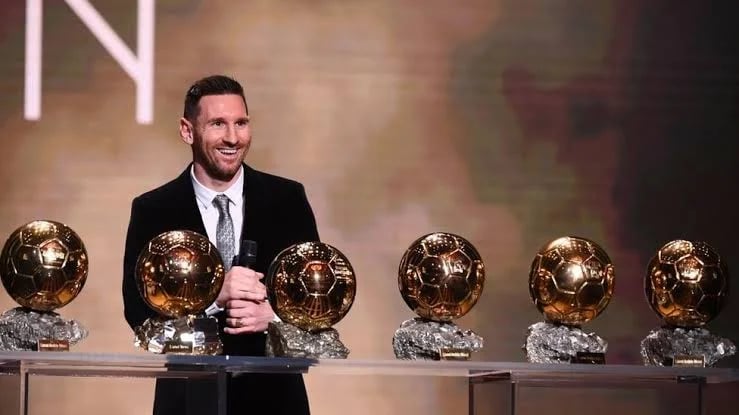
| Lionel Messi | 8 | 2009, 2010, 2011, 2012, 2015, 2019, 2021, 2023 |
| Cristiano Ronaldo | 5 | 2008, 2013, 2014, 2016, 2017 |
Where the record sits
Ronaldo’s Ballon d’Or history is really a study in adaptation. He first won as a young attacker built on pace and dribbling, then reinvented himself as a ruthless penalty-box scorer in Spain and kept collecting the same trophy. The shape of his margins tells a parallel story: the knife-edge win of 2013 gave way to the emphatic spreads of 2016 and 2017, when Madrid’s European dominance made his candidacy hard to argue against.
Messi has since pulled ahead in the overall count, and the two are no longer level as they briefly were at the end of 2017. Even so, five Ballon d’Or trophies won over nine years and across three formats of the award remain one of the defining individual records the sport has produced, and the neat rivalry with Messi, who finished as his runner-up every single time, is unlikely to be matched.