No individual honour in football carries the weight of the Ballon d’Or. Launched by the French magazine France Football in 1956 as a poll of European sportswriters, it set out to name the best player on the continent and ended up building the closest thing the sport has to an official canon of greatness. Read from top to bottom, the list of winners doubles as a history of how football itself has changed: who played it, where, and in what style.
This is a verified walk through that history, the winners, the rule changes that widened the field, and the marks that no one has yet erased.
A European prize is born
The first award, in 1956, went to Stanley Matthews of Blackpool and England. He was 41 at the time, and he remains the oldest man ever to win it. That detail says a lot about the early voting: reputation, craft and a long body of work counted for as much as one blazing season. For decades the rules also limited eligibility to players who held a European nationality, which naturally anchored the honour around the leading clubs and national sides of the continent.
Real Madrid dominated the award’s opening chapter much as they dominated the European Cup. Alfredo Di Stéfano, the Argentine engine of that side, won in 1957 and 1959, with his teammate Raymond Kopa taking the 1958 edition. The 1960s then delivered a procession of era-defining names: Luis Suárez, Omar Sívori, Josef Masopust, Denis Law, Eusébio, Bobby Charlton, Flórián Albert and George Best. One winner from that decade sits entirely alone in the record books. In 1963 Lev Yashin of Dynamo Moscow and the Soviet Union became the only goalkeeper ever to lift the prize, a distinction that has outlasted every reform since.
1963Yashin, the only goalkeeper to winTotal Football and the great runs of the 1970s and 1980s
Dutch and German football set the tone through the 1970s. Johan Cruyff, the face of Total Football, won three times (1971, 1973 and 1974), while Franz Beckenbauer, the elegant sweeper who redefined defending, took the honour in 1972 and 1976. Gerd Müller, Oleg Blokhin, Allan Simonsen and a back-to-back double for Kevin Keegan rounded out a decade shaped by pressing, positional fluidity and the attacking libero.
The 1980s produced the award’s first great streak. Karl-Heinz Rummenigge won in 1980 and 1981, but the headline belonged to Michel Platini, whose three consecutive titles from 1983 to 1985, all with Juventus, made him the first man to win in three straight years. That run stood as the benchmark for sustained individual excellence until the modern era. The decade closed with AC Milan’s Dutch core in full flow: Ruud Gullit won in 1987 and Marco van Basten in 1988 and 1989, with van Basten adding a third crown in 1992.
Two reforms that opened the door
For most of its life the Ballon d’Or was, in practice, a European players’ award. Two changes turned it into something genuinely global. The first came in 1995, when eligibility was widened to include any player at a European club, whatever their nationality. The immediate winner under the new rule was George Weah of AC Milan, the first African and the first non-European recipient, a result that mirrored how cosmopolitan Europe’s top leagues had already become.
The second, larger step arrived in 2007, when the field was opened to players anywhere in the world, at any club on any continent. By then the roll of honour had already stretched well beyond Europe in spirit if not in letter, thanks to a golden run of Brazilians. Ronaldo won in 1997 and 2002, with Rivaldo (1999), Ronaldinho (2005) and Kaká (2007) following, alongside Zinedine Zidane, Luís Figo, Michael Owen, Pavel Nedvěd, Andriy Shevchenko and Fabio Cannavaro. Cannavaro’s 2006 win, off the back of Italy’s World Cup, made him a rare centre-back to top the poll.
The Messi and Ronaldo years
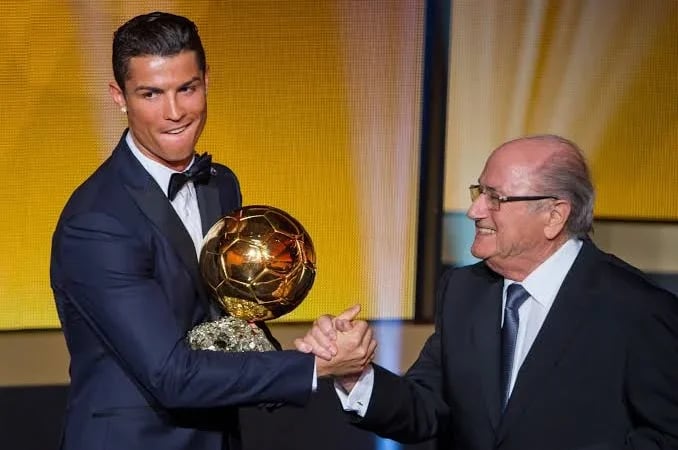
From 2008 the award narrowed to a two-man argument that would run for well over a decade. Cristiano Ronaldo won first, in 2008 with Manchester United. Lionel Messi answered with four titles in a row from 2009 to 2012, a level of sustained supremacy football had never seen. Between them, the pair claimed twelve of the thirteen awards handed out from 2008 to 2021. The only interruption came in 2018, when Luka Modrić won after captaining Croatia to the World Cup final and anchoring Real Madrid’s third straight European title.
This period also brought the award’s biggest administrative shake-up. From 2010 to 2015 the Ballon d’Or merged with FIFA’s World Player of the Year to create the FIFA Ballon d’Or, run jointly by France Football and world football’s governing body. The partnership ended after 2015, and France Football took sole charge of the award again from 2016.
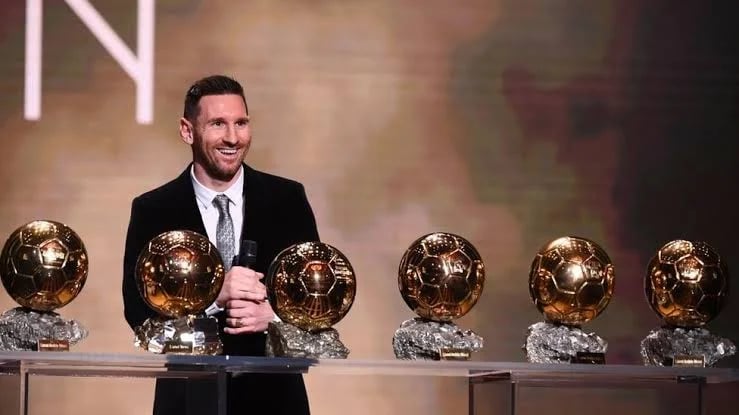
Messi eventually pushed his total to eight, adding wins in 2015, 2019, 2021 and 2023. The last of those followed the crowning achievement of his career, the 2022 World Cup with Argentina, by which point he was playing his club football in Major League Soccer with Inter Miami. Ronaldo closed his own tally at five, with further titles in 2013, 2014, 2016 and 2017.
A new calendar and new kinds of winner
The end of the duopoly coincided with another structural change. Beginning with the 2021-22 cycle, France Football moved the assessment window away from the calendar year and onto a full football season, running from roughly August to July, so that the vote lined up with how a campaign actually plays out. Karim Benzema won under that new framework in 2022 after a decisive season with Real Madrid.
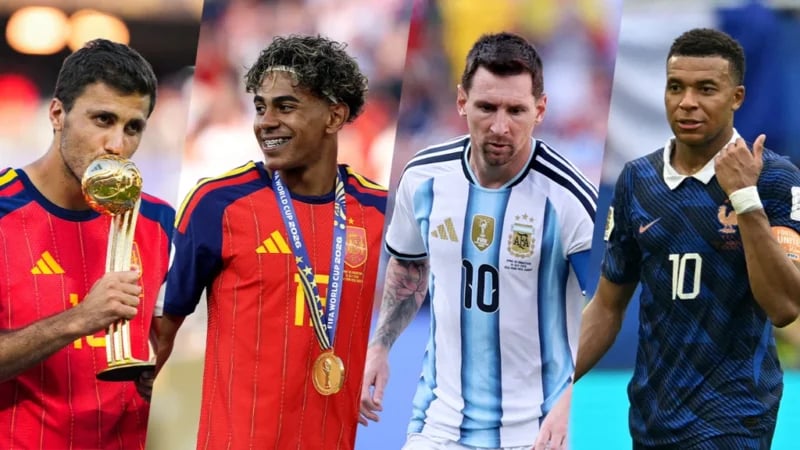
The two awards that followed pointed to a shift in what voters reward. In 2024 Rodri of Manchester City and Spain took the prize, a rare defensive midfielder to finish first. His case rested on control rather than goals: a fourth straight Premier League title with City and the player-of-the-tournament award at the 2024 European Championship, which Spain won. He became the first Manchester City player and only the second Spanish man to win, after Luis Suárez in 1960.
In 2025 the honour went to Ousmane Dembélé of Paris Saint-Germain, who edged Barcelona’s teenage forward Lamine Yamal by a wide margin. Dembélé’s season was the standout of his career: he was central to a Paris side that completed a domestic and European treble, winning Ligue 1, the Coupe de France and the club’s first UEFA Champions League, sealed with a 5-0 win over Inter in the final in Munich. He became the sixth Frenchman to win, joining Kopa, Platini, Jean-Pierre Papin, Zidane and Benzema.
Every men’s winner, year by year
The 2020 edition is the only gap in the sequence. France Football cancelled it, pointing to the disruption the COVID-19 pandemic caused across the season, leaving that year without a winner for the first and only time since 1956.
| Year(s) | Winner | Country | Note |
|---|---|---|---|
| 1956 | Stanley Matthews | England | Inaugural winner, oldest recipient |
| 1957, 1959 | Alfredo Di Stéfano | Argentina | Real Madrid |
| 1958 | Raymond Kopa | France | Real Madrid |
| 1960 | Luis Suárez | Spain | FC Barcelona |
| 1961 | Omar Sívori | Italy | Juventus |
| 1962 | Josef Masopust | Czechoslovakia | Dukla Prague |
| 1963 | Lev Yashin | Soviet Union | Only goalkeeper to win |
| 1964 | Denis Law | Scotland | Manchester United |
| 1965 | Eusébio | Portugal | Benfica |
| 1966 | Bobby Charlton | England | Manchester United |
| 1967 | Flórián Albert | Hungary | Ferencváros |
| 1968 | George Best | Northern Ireland | Manchester United |
| 1969 | Gianni Rivera | Italy | AC Milan |
| 1970 | Gerd Müller | West Germany | Bayern Munich |
| 1971, 1973, 1974 | Johan Cruyff | Netherlands | Three-time winner |
| 1972, 1976 | Franz Beckenbauer | West Germany | Bayern Munich |
| 1975 | Oleg Blokhin | Soviet Union | Dynamo Kyiv |
| 1977 | Allan Simonsen | Denmark | Borussia Mönchengladbach |
| 1978, 1979 | Kevin Keegan | England | Hamburger SV |
| 1980, 1981 | Karl-Heinz Rummenigge | West Germany | Bayern Munich |
| 1982 | Paolo Rossi | Italy | Juventus |
| 1983, 1984, 1985 | Michel Platini | France | Three straight titles |
| 1986 | Igor Belanov | Soviet Union | Dynamo Kyiv |
| 1987 | Ruud Gullit | Netherlands | AC Milan |
| 1988, 1989, 1992 | Marco van Basten | Netherlands | Three-time winner |
| 1990 | Lothar Matthäus | Germany | Inter Milan |
| 1991 | Jean-Pierre Papin | France | Olympique de Marseille |
| 1993 | Roberto Baggio | Italy | Juventus |
| 1994 | Hristo Stoichkov | Bulgaria | FC Barcelona |
| 1995 | George Weah | Liberia | First non-European winner |
| 1996 | Matthias Sammer | Germany | Borussia Dortmund |
| 1997, 2002 | Ronaldo | Brazil | Two-time winner |
| 1998 | Zinedine Zidane | France | Juventus |
| 1999 | Rivaldo | Brazil | FC Barcelona |
| 2000 | Luís Figo | Portugal | Real Madrid |
| 2001 | Michael Owen | England | Liverpool |
| 2003 | Pavel Nedvěd | Czech Republic | Juventus |
| 2004 | Andriy Shevchenko | Ukraine | AC Milan |
| 2005 | Ronaldinho | Brazil | FC Barcelona |
| 2006 | Fabio Cannavaro | Italy | Real Madrid |
| 2007 | Kaká | Brazil | Eligibility opened worldwide |
| 2008, 2013, 2014, 2016, 2017 | Cristiano Ronaldo | Portugal | Five-time winner |
| 2009, 2010, 2011, 2012, 2015, 2019, 2021, 2023 | Lionel Messi | Argentina | Record eight wins |
| 2018 | Luka Modrić | Croatia | Real Madrid |
| 2020 | Not awarded | n/a | Cancelled amid the pandemic |
| 2022 | Karim Benzema | France | Real Madrid |
| 2024 | Rodri | Spain | Manchester City |
| 2025 | Ousmane Dembélé | France | Paris Saint-Germain |
What the roll of honour tells us
Taken as a whole, the Ballon d’Or works as both a hall of fame and a record of the sport’s widening horizons. Its winners moved from a strictly European cast to a truly worldwide one, its administration merged with FIFA and then split away again, and its calendar was rebuilt to fit the modern season. Two records frame everything else on the list: Yashin as the only goalkeeper ever to win, and Messi’s eight titles, a total that sits clear of even Ronaldo’s five. What has not changed is the basic idea. Year after year the prize goes to the player who best defines the moment, and for that reason its list of names remains the single clearest story the game tells about individual greatness.