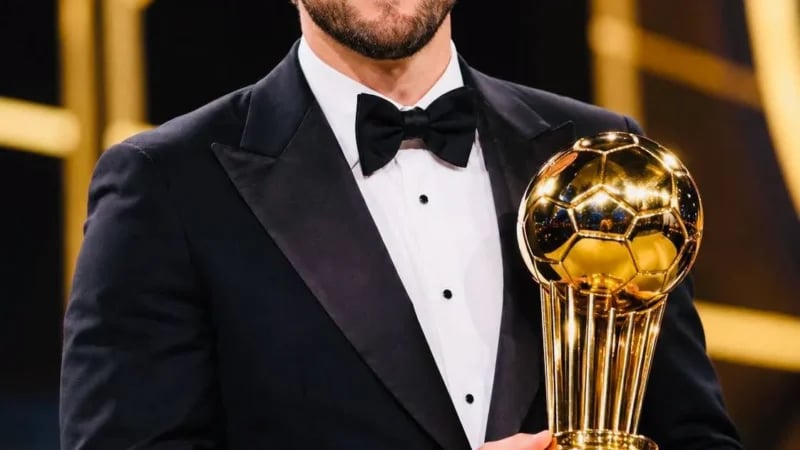
When the Kopa Trophy was handed out at the 2026 Ballon d’Or ceremony in London on 26 October 2026, the name read out had been read out before. Twice, in fact. Lamine Yamal took the award again, and in doing so turned a young players’ prize into something closer to a personal dynasty. The Barcelona forward now holds the Kopa Trophy for 2024, 2025 and 2026, the only player to win it more than once and the first to win it three times.
The Kopa Trophy, named after the France Football Ballon d’Or winner Raymond Kopa, has been presented since 2018 to the best performing player in the world aged 21 or under. It is voted on by previous Ballon d’Or winners, which gives it a particular weight: this is a group of elite players judging who, among the game’s youngest talents, has done the most on the biggest stages. Until Yamal, no name had ever appeared on the trophy twice. He has now rewritten that short history on his own.
A record built in three steps
The scale of the achievement is easier to grasp alongside the full list of winners. Every previous recipient claimed the award once and then, by definition, aged out of eligibility or was overtaken by the next wave. Yamal has instead stacked three in a row while still inside the age bracket, a pattern the prize had never seen.
| Year | Winner | Club at the time |
|---|---|---|
| 2018 | Kylian Mbappé | Paris Saint-Germain |
| 2019 | Matthijs de Ligt | Juventus |
| 2020 | Not awarded | , |
| 2021 | Pedri | Barcelona |
| 2022 | Gavi | Barcelona |
| 2023 | Jude Bellingham | Borussia Dortmund |
| 2024 | Lamine Yamal | Barcelona |
| 2025 | Lamine Yamal | Barcelona |
| 2026 | Lamine Yamal | Barcelona |
The names above read like a roll call of modern football’s most coveted graduates. Mbappé went on to global superstardom. Pedri and Gavi became the midfield heartbeat of a rebuilt Barcelona. Bellingham turned a single move into one of the most talked-about transfers of his generation. Each won the Kopa once. Yamal, uniquely, kept coming back to the podium.
3consecutive Kopa Trophy wins (2024, 2025, 2026)The 2020 gap on the list is worth a footnote. That edition of the Ballon d’Or and its associated prizes was not staged, which is why the sequence jumps from De Ligt to Pedri. It is the only year since the award’s creation that no winner was named.
The season behind the 2026 award
Awards like this one are retrospective. The 2026 Kopa Trophy rewards the body of work across the preceding campaign, and by every account Yamal’s was exceptional. He was central to Barcelona’s La Liga title and a key figure in Spain’s run to the 2026 World Cup, playing from the right flank where his close control, direct dribbling and left foot have become his signature.
On the raw output, the public record is slightly messy, and it is worth being honest about that rather than inventing a clean line. Different outlets reported the season in slightly different terms. One widely circulated report credited him with 24 goals and 18 assists across 45 matches, while other aggregated figures pointed toward tallies nearer 25 goals and 20 assists. The exact final number is not uniformly sourced across publications. What is not in dispute is the shape of it: a return in the mid-20s for goals and close to 20 assists, numbers that would be striking for a seasoned senior international and are startling for a player still young enough to qualify for an under-21 award.
The assist column is the part that often gets lost in the highlight reels. A player can win a young talent award on flair alone, on the clips that travel well on a phone screen. Yamal’s profile is broader than that. He creates as readily as he scores, which is why his influence shows up in title races and tournament runs rather than only in individual montages.
Why the three-peat matters
There is a structural reason the Kopa Trophy is so hard to win repeatedly. The eligibility window closes at 21, so most players have only one or two realistic cracks at it before they graduate into the senior conversation and compete directly for the Ballon d’Or itself. To win three times, a player has to arrive in the first team extraordinarily young, perform at a world-class level immediately, and sustain that level across three separate seasons while still inside the age limit. Yamal’s path cleared all three hurdles.
It also reframes how we read the trophy’s own prestige. For most of its existence the Kopa was a signpost, a prize that said “watch this player, they are about to become central to the senior game.” In Yamal’s case it has instead become a measure of sustained excellence inside youth, a rare thing because the category tends to churn its contenders out so quickly. By winning it three times, he has effectively redefined what a ceiling performance in this bracket looks like.
Context among the greats who won it once
Comparison is unavoidable and, handled carefully, useful. Mbappé’s single Kopa in 2018 came in the same window as a World Cup triumph with France, and he was widely seen as the defining young player of his era. He did not win the award again, not because he declined but because the next cohort arrived. That is the normal rhythm of the prize. Pedri and Gavi, both Barcelona academy products, each took one and then moved into the senior midfield conversation. Bellingham’s 2023 win preceded a career that quickly outgrew the under-21 label entirely.
Against that backdrop, three consecutive wins for one player is not a quirk of weak competition. The field over Yamal’s three winning years included other highly rated young players across Europe’s major leagues. He simply kept beating them, as judged by a voting body of former Ballon d’Or winners who have little incentive to reward anything other than genuine, visible quality.
2018first year the Kopa Trophy was awardedThe analytical takeaway
The temptation with a young player who wins everything early is to treat the records as a prelude, to say the real story starts once he moves into the senior awards race. That misreads what the Kopa three-peat actually tells us. It is a completed, bounded achievement: a player entered a category, dominated it for the maximum realistic stretch, and left a record that by the rules of the award cannot easily be matched. Future players will win the Kopa Trophy. Winning it three times, inside a window that closes at 21, requires a combination of early arrival and sustained production that may not recur for a long while.
For Barcelona and for Spain, the more immediate value is obvious. The club secured a league title and the national team won a World Cup with Yamal as a primary attacking threat, and both benefited from a player producing senior-level numbers at an age when most are still establishing themselves. The Kopa Trophy, three years deep, is the formal acknowledgment of that. The next chapter, the senior Ballon d’Or conversation, is a different competition. What he did in the under-21 bracket is already settled, and it is already unprecedented.