FC Barcelona Femeni were crowned Women’s Club of the Year at the 2026 Ballon d’Or ceremony, a recognition that functioned less as a surprise than as a formality. By the time the award was read out, the Catalan club had already settled the argument on the pitch across nine months of near-perfect football, sweeping the trophies that matter at home and in Europe. The citation framed Barcelona as the standard-bearer for the women’s game, a side that pairs technical refinement with a winning habit that rarely slips.
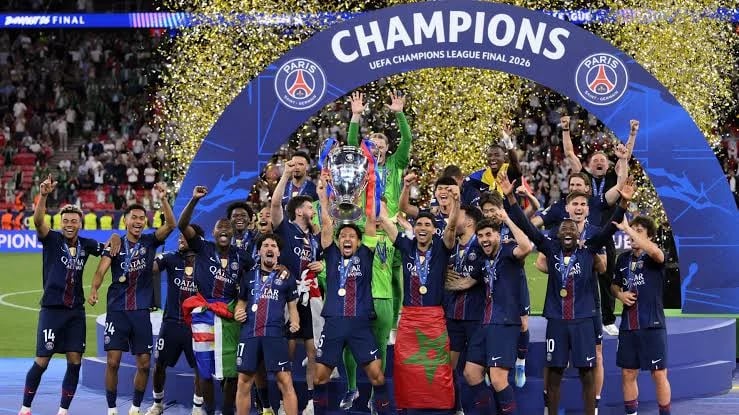
Club of the Year is one of the collective honours handed out alongside the individual Ballon d’Or prizes, and it rewards the body of work a team produces across a full season rather than a single result. For Barcelona, that body of work was unusually complete. The same ceremony named Paris Saint-Germain as the men’s Club of the Year, but it was the women’s section of the Catalan club that arrived with the fuller trophy haul.
The season that justified the award
The foundation was Liga F. Barcelona retained the Spanish league title, their seventh in succession, with the championship mathematically secured on 22 April 2026. Domestic dominance is nothing new for the club, but a seventh consecutive crown underlined how firmly the team has set the terms of the competition. Across the campaign the side combined possession-heavy control with the ruthlessness to turn territory into goals, a blend that has become the club’s signature under its recent coaching regimes.
Alongside the league came the Copa de la Reina, Spain’s premier women’s knockout competition, and the Supercopa de Espana Femenina, the season-opening showcase between the country’s leading sides. Winning both meant Barcelona had locked up the full domestic set before the European decider even arrived. That treble at home is the sort of clean sweep most clubs treat as a landmark season in its own right.
The crowning result came on 23 May 2026, when Barcelona defeated Lyon 4-0 in the UEFA Women’s Champions League final. The margin mattered. A four-goal win over Lyon, historically the most decorated club in the competition, was an emphatic statement rather than a narrow escape, and it completed what the club records as its second continental quadruple and third continental treble. The Champions League has become the measure by which the modern Barcelona project is judged, and lifting it to cap a quadruple left little room for debate about the team’s standing.
| Competition | Outcome 2025-26 | Note |
|---|---|---|
| Liga F | Champions | Seventh consecutive title, secured 22 April 2026 |
| Copa de la Reina | Champions | National knockout cup |
| Supercopa de Espana Femenina | Champions | Spanish super cup |
| UEFA Women’s Champions League | Champions | Beat Lyon 4-0 in the final, 23 May 2026 |
| Copa Catalunya Femenina (2024-25) | Champions | Postponed edition played August 2025 |
Counting the trophies: four, or five?
Depending on how the campaign is framed, Barcelona raised either four or five trophies across 2025-26. The continental quadruple refers to the four competitions won within the season proper: Liga F, the Copa de la Reina, the Supercopa, and the Champions League. The fifth piece of silverware was the Copa Catalunya Femenina, the regional Catalan cup, whose 2024-25 edition had been postponed and was eventually played in August 2025. That meant the club lifted it during the same calendar window as the rest of its run, accounting for a fifth trophy raised across the campaign.
There is a nuance worth preserving here for the record. Barcelona could not defend the Copa Catalunya in 2025-26 itself because of rule changes affecting the competition, so the fifth trophy belongs to a carried-over edition rather than a parallel fifth title won within the season’s own four major competitions. The cleaner, more defensible framing is the quadruple: four honours won inside the 2025-26 season, with the regional cup as an additional, earlier triumph.
Why the award carries weight
Collective awards can feel like consolation decorations, handed out to round off a ceremony dominated by individual prizes. Barcelona’s case is different because the season behind it was so comprehensive. A quadruple leaves no obvious counter-argument: there is no domestic trophy the team failed to win, and no European final it failed to reach and settle. When a club takes every title available to it and does so with a four-goal win in the continental final, the Club of the Year citation reads as description rather than opinion.
The win also fits a longer trajectory. Barcelona have spent several seasons establishing themselves as the reference point for the women’s club game in Europe, building a style that other sides now measure themselves against. Seven straight league titles at home speak to sustained institutional strength rather than a single golden campaign, and repeated appearances at the business end of the Champions League have made the club a fixture in the sport’s most important fixtures. The quadruple of 2025-26 is best understood as the peak expression of that sustained project rather than a bolt from the blue.
The European dimension
What separated 2025-26 from a merely excellent domestic season was the European result. Winning Liga F and the two domestic cups confirms superiority within Spain, but the Champions League tests a team against the best of England, France, Germany and beyond. Beating Lyon in the final, and beating them decisively, closed off the one line of argument a rival might have raised. It is the difference between the strongest team in a single country and the strongest club on the continent, and Barcelona claimed both descriptions in the same campaign.
The pairing with Paris Saint-Germain on the men’s side of the Club of the Year ledger gave the 2026 ceremony a neat symmetry, two clubs recognised for seasons of collective excellence. For Barcelona Femeni, though, the honour slots into a growing collection and reinforces a simple reference-book fact about this era of the women’s game: when the sport’s major awards are totted up, the Catalan club is rarely far from the top of the list.
The takeaway
FC Barcelona Femeni’s 2026 Club of the Year award is one of those honours that the season itself had already written. A continental quadruple, a seventh straight league title, a 4-0 Champions League final, and an additional regional cup lifted along the way amount to a campaign with almost no blemish. Collective awards reward exactly that kind of completeness, and in a year when the club won essentially everything in front of it, the recognition reads as the logical final entry on a season-long ledger rather than a separate achievement. For the reference record, 2025-26 stands as one of the defining campaigns of the modern women’s game, and the Club of the Year trophy is its fitting footnote.