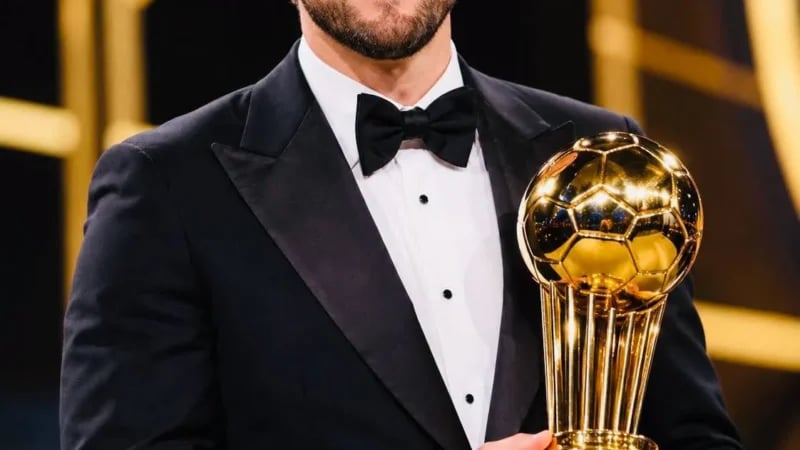
The Ballon d’Or, handed out by the French magazine France Football since 1956, is the oldest and most closely watched individual prize in the sport. Sorting its winners by nationality turns a list of great players into a map of where footballing excellence has been concentrated, and it produces a table with one clear leader, a dense chasing pack, and a long tail of countries that have celebrated a single laureate.
Across the awards handed out from 1956 through the most recent edition, twenty different nations have produced at least one winner. That spread is wider than many assume, but the wins themselves are unevenly distributed: a handful of countries account for the overwhelming majority, and one stands apart.
How the count is built
Any by-nation ranking of the Ballon d’Or has to reckon with the award’s shifting eligibility. From its creation until 1994 the prize was open only to European players, which is why the early honour roll is entirely a European affair. In 1995 the criteria widened to any player at a European club, a change that immediately produced George Weah of Liberia as the first non-European winner. From 2007 the vote opened to players anywhere in the world, and between 2010 and 2015 the award merged with the FIFA World Player prize as the FIFA Ballon d’Or, a period France Football continues to include in its official palmarès.
Two winners sit awkwardly across national lines, and any honest tally has to flag them. Alfredo Di Stéfano, who won in 1957 and 1959, was born in Buenos Aires and played for Argentina before representing Spain; he is most commonly credited to Argentina in these breakdowns. Omar Sívori, the 1961 winner, was likewise Argentine-born but took Italian citizenship and played for Italy’s national team, so he is generally counted for Italy as an oriundo. The figures below follow those conventions, and note where a different choice would shift a total.
Argentina out in front
Argentina’s position at the summit is a recent phenomenon built on a singular career. Lionel Messi has won the award eight times (2009, 2010, 2011, 2012, 2015, 2019, 2021 and 2023), more than any individual in the prize’s history. Add Di Stéfano’s two victories and Argentina reaches ten, clear of the field by three.
8Messi's record individual winsThe scale of that is worth pausing on. Messi’s personal total matches or beats the entire national output of every country apart from the four sharing second place. Before his emergence, Argentina had exactly two winners on the board, both Di Stéfano, and no country would have picked the nation as a likely all-time leader. One player rewrote the ranking.
| Rank | Nation | Wins | Winners |
|---|---|---|---|
| 1 | Argentina | 10 | Messi (8), Di Stéfano (2) |
| 2= | Germany | 7 | Beckenbauer (2), Rummenigge (2), G. Müller, Matthäus, Sammer |
| 2= | Netherlands | 7 | Cruyff (3), Van Basten (3), Gullit |
| 2= | France | 7 | Platini (3), Kopa, Papin, Zidane, Benzema |
| 2= | Portugal | 7 | Cristiano Ronaldo (5), Eusébio, Figo |
| 6= | Brazil | 5 | Ronaldo (2), Rivaldo, Ronaldinho, Kaká |
| 6= | England | 5 | Keegan (2), Matthews, Charlton, Owen |
| 6= | Italy | 5 | Rivera, Rossi, Baggio, Cannavaro, Sívori |
| 9 | Soviet Union | 3 | Yashin, Blokhin, Belanov |
| 10 | Spain | 2 | L. Suárez, Rodri |
The four-way tie on seven
Immediately behind Argentina sits one of the neatest coincidences in the whole record: four countries level on seven wins apiece, each reaching the mark by a different route.
Germany’s seven (counting West Germany) come from a spread of eras and profiles. Gerd Müller took the 1970 award, Franz Beckenbauer won twice as the game’s defining libero (1972 and 1976), Karl-Heinz Rummenigge went back-to-back in 1980 and 1981, Lothar Matthäus followed in 1990 on the back of a World Cup triumph, and Matthias Sammer closed the run in 1996. It is a portrait of sustained tournament pedigree rather than a single dominant figure.
The Netherlands packed its seven into a tighter window and a distinctive style. Johan Cruyff won three (1971, 1973, 1974), the twin pillars of Total Football, and Marco van Basten matched him with three of his own (1988, 1989, 1992), separated by Ruud Gullit’s victory in 1987. For a country that has never won a men’s World Cup, a total level with Germany’s is a striking marker of influence.
France’s seven blend generations too. Raymond Kopa opened the account in 1958, Michel Platini authored one of the great individual streaks with three in a row (1983, 1984, 1985), Jean-Pierre Papin added 1991, Zinedine Zidane won in 1998, and Karim Benzema took the 2022 prize to keep France in the group.
Portugal is the outlier of the quartet because its seven lean so heavily on one man. Cristiano Ronaldo won five times (2008, 2013, 2014, 2016 and 2017), bracketed by Eusébio in 1965 and Luís Figo in 2000. Strip out Ronaldo and Portugal would sit on two.
Brazil, England and Italy on five
A second cluster forms on five wins. Brazil’s tally is spread across its post-1994 global era: Ronaldo won in 1997 and 2002, with Rivaldo (1999), Ronaldinho (2005) and Kaká (2007) filling in the years around them. Given Brazil’s five World Cups, five Ballon d’Or winners can look modest, a reminder that for most of the award’s life its best players were ineligible.
England also reaches five, all from a concentrated golden run of home talent: Stanley Matthews as the inaugural 1956 winner, Bobby Charlton in 1966, Kevin Keegan back-to-back in 1978 and 1979, and Michael Owen in 2001. Italy’s five come from Gianni Rivera (1969), Paolo Rossi (1982), Roberto Baggio (1993), Fabio Cannavaro (2006) and, by the oriundo convention, Sívori (1961). Assign Sívori to Argentina instead and Italy drops to four while Argentina climbs to eleven.
The single-winner nations and the long tail
Below the leaders, the Soviet Union stands on three, courtesy of goalkeeper Lev Yashin (still the only keeper to win, in 1963), Oleg Blokhin (1975) and Igor Belanov (1986). Spain sits on two through Luis Suárez in 1960 and Rodri in 2024, the most recent name added to the honour roll.
Ten further countries have produced exactly one winner, a roll call that captures the award’s geographic reach: Czechoslovakia (Josef Masopust, 1962), Scotland (Denis Law, 1964), Hungary (Flórián Albert, 1967), Northern Ireland (George Best, 1968), Denmark (Allan Simonsen, 1977), Bulgaria (Hristo Stoichkov, 1994), Liberia (George Weah, 1995), the Czech Republic (Pavel Nedvěd, 2003), Ukraine (Andriy Shevchenko, 2004) and Croatia (Luka Modrić, 2018). Modrić’s win is notable for a separate reason: it broke the Messi-Ronaldo monopoly that had run unbroken for a decade.
20nations with a Ballon d'Or winnerThe takeaway
Read as a whole, the by-nation table tells two stories at once. The first is about breadth: twenty countries across four decades of eligibility rules have put a name on the trophy, from Liberia to Croatia to the Soviet Union. The second is about concentration, and it is the stronger signal. A single generation reordered the top of the list, with Messi hauling Argentina clear and Cristiano Ronaldo dragging Portugal into a four-way tie for second. Below them, the balance among Germany, the Netherlands, France, Portugal, Brazil, England and Italy reflects the long middle history of European club football. The leaderboard is less a ranking of national footballing cultures than a record of which players the award happened to be open to, and which of them reached a level no voter could ignore.