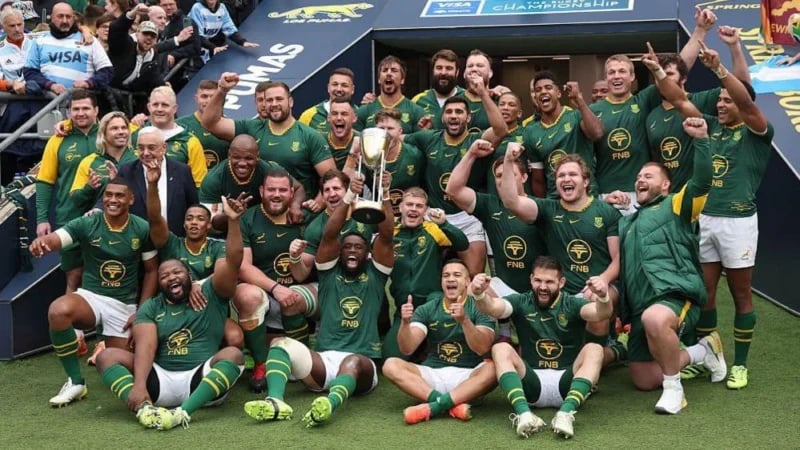
No nation has left a deeper imprint on the Rugby World Cup than South Africa. The Springboks arrived late to the competition, kept out of the first two editions by the sporting isolation of the apartheid era, yet they have gone on to lift the Webb Ellis Cup four times. That is the outright record, one clear of New Zealand, and it has been assembled across nearly three decades and four very different eras of the game.
What makes the South African story distinctive is not just the volume of titles but the manner of them. Two came on home-continent soil early, two came away in Europe and Asia, and each of the four finals was won by a margin of ten points or fewer. The Springboks have become synonymous with knockout rugby played on the finest of edges, decided by a boot, a drop goal, or a defensive stand in the closing minutes.
A delayed debut and an instant coronation in 1995
South Africa did not appear at the inaugural World Cup in 1987 or the 1991 edition, excluded while the country remained outside international sport. Readmission came in the early 1990s, and the timing proved extraordinary: South Africa was awarded hosting rights for the 1995 tournament, its first appearance in the competition.
The Springboks won it. Captained by Francois Pienaar and coached by Kitch Christie, the hosts came through the pool stage and knockout rounds to meet New Zealand, and the fearsome Jonah Lomu, in the final at Ellis Park in Johannesburg. The match went to extra time locked at 9-9, and it was fly-half Joel Stransky who settled it with a drop goal, sealing a 15-12 win. The image of President Nelson Mandela handing the trophy to Pienaar while wearing a Springbok jersey became one of the defining moments of modern sport, reaching far beyond the pitch.
15-121995 final vs New Zealand, after extra timeRedemption in Paris, 2007
After a semi-final exit as defending champions in 1999 and a quarter-final defeat in 2003, South Africa rebuilt under coach Jake White and returned to the summit in France in 2007. The pool stage offered an early statement: the Springboks dismantled England 36-0. The two sides met again in the final at the Stade de France in Paris, and this time the margin was tighter but the outcome the same.
South Africa won 15-6, a final decided entirely by kicks, with full-back Percy Montgomery and the young Frans Steyn supplying the points. Captain John Smit lifted the trophy, and the tournament confirmed a template the Springboks would return to repeatedly: a dominant set-piece, relentless defence, and a goal-kicker who does not miss. A famous try-line stand, when England’s Mark Cueto was ruled to have put a foot in touch before grounding, underlined how fine the margins had become.
A captain for the ages in 2019
South Africa’s third title, in Japan in 2019, carried significance that stretched well beyond rugby. Siya Kolisi captained the side, the first Black player to lead the Springboks at a World Cup and then to win one. Under director of rugby Rassie Erasmus, a team that had lost its opening pool match to New Zealand regrouped and grew stronger with every round.
The final in Yokohama produced South Africa’s most emphatic World Cup decider. Facing England, who had beaten New Zealand in the semi-final, the Springboks won 32-12. Handré Pollard was metronomic from the tee, and in the closing quarter South Africa scored the first two tries by a Springbok side in a World Cup final, through Makazole Mapimpi and the elusive Cheslin Kolbe. It was the largest winning margin of any South African final and drew the country level with New Zealand on three titles apiece.
Four of one point: the 2023 knockout gauntlet
The 2023 campaign in France may be the hardest World Cup any team has ever won. With Jacques Nienaber as head coach and Erasmus overseeing the wider setup, South Africa negotiated a brutal knockout draw by the narrowest possible margins in three consecutive matches.
In the quarter-final the Springboks edged the hosts France 29-28. In the semi-final they beat England 16-15, Pollard landing a long-range penalty in the final minutes. And in the final at the Stade de France they overcame New Zealand 12-11. The All Blacks played much of the match with fourteen men after captain Sam Cane was shown a red card, but South Africa still had to survive to the finish, defending their lead through four Pollard penalties. It was the first time a nation had reached a fourth World Cup title, and the Springboks did it by winning three straight knockout games by a single point.
| Year | Host | Opponent in final | Score | Captain |
|---|---|---|---|---|
| 1995 | South Africa | New Zealand | 15-12 (a.e.t.) | Francois Pienaar |
| 2007 | France | England | 15-6 | John Smit |
| 2019 | Japan | England | 32-12 | Siya Kolisi |
| 2023 | France | New Zealand | 12-11 | Siya Kolisi |
Where the record sits among the great rugby nations
Placed against the rest of the field, South Africa’s haul stands alone. New Zealand has won the title three times (1987, 2011 and 2015). Australia has two (1991 and 1999). England remains the only side from the Northern Hemisphere to win it, in 2003. That leaves the Springboks as the tournament’s most successful team by a full title, a lead built despite missing the first two editions entirely.
| Nation | Titles | Years won |
|---|---|---|
| South Africa | 4 | 1995, 2007, 2019, 2023 |
| New Zealand | 3 | 1987, 2011, 2015 |
| Australia | 2 | 1991, 1999 |
| England | 1 | 2003 |
There is a stylistic thread running through the record. Three of the four South African titles were won by margins of nine points or fewer, and the 2023 knockout run turned tight-game management into an identity. The Springboks have rarely been the tournament’s most expansive attacking side, but they have repeatedly been its most durable, built on a heavyweight forward pack, a kicking game that squeezes territory, and a defensive system that forces opponents to earn every metre. The 2019 innovation of a so-called “bomb squad”, a bench weighted heavily toward forwards, took that philosophy to a new extreme and has since been widely imitated.
The takeaway
South Africa’s relationship with the Rugby World Cup began under a cloud and turned into the competition’s defining success story. From Stransky’s drop goal and Mandela’s jersey in 1995 to Kolisi lifting the trophy for a second time in 2023, the Springboks have made the tournament their own. They arrived two editions late and still finished first, and the way they did it, on the tightest of margins with a game built for the final quarter, is as much a part of the record as the four titles themselves.