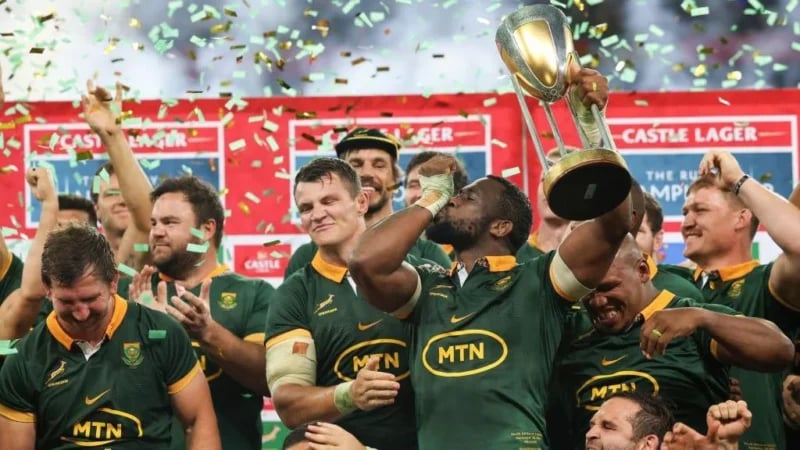
The short answer is four. South Africa has won the Rugby World Cup in 1995, 2007, 2019 and 2023, which makes the Springboks the most successful nation in the competition’s history, one title clear of New Zealand’s three. The longer answer is more interesting, because those four trophies were gathered from only seven appearances. South Africa did not play in the first two editions at all, so its winning rate stands apart from every rival that has been present since the beginning.
Understanding the tally means starting with an absence. When the inaugural tournament was hosted by Australia and New Zealand in 1987, and when the home unions and France staged the second edition in 1991, South Africa was excluded from international sport because of the boycott linked to apartheid. Readmission arrived only at the start of the 1990s. As a result, the Springboks’ entire World Cup record begins in 1995, and that first campaign turned into one of the most celebrated debuts in the sport.
The four titles at a glance
| Year | Host | Final opponent | Score | Captain | Head coach |
|---|---|---|---|---|---|
| 1995 | South Africa | New Zealand | 15-12 (a.e.t.) | Francois Pienaar | Kitch Christie |
| 2007 | France | England | 15-6 | John Smit | Jake White |
| 2019 | Japan | England | 32-12 | Siya Kolisi | Rassie Erasmus |
| 2023 | France | New Zealand | 12-11 | Siya Kolisi | Jacques Nienaber |
1995: winning on debut
South Africa arrived at its first World Cup as host and left it as champion. Coached by Kitch Christie and captained by the flanker Francois Pienaar, the team won all six of its matches. The final against New Zealand at Ellis Park in Johannesburg was level at 9-9 after eighty minutes and went to extra time, where the fly-half Joel Stransky struck a drop goal to seal a 15-12 victory. New Zealand’s rampaging wing Jonah Lomu, who had overwhelmed defences all tournament, was largely shut down by a disciplined Springbok effort.
The moment that followed became one of the enduring images of twentieth century sport: President Nelson Mandela, wearing a Springbok jersey, presenting the Webb Ellis Cup to Pienaar. It gave the result a weight far beyond rugby. Worth noting for the record, 1995 was also one of only two occasions on which the host nation has won the tournament. The other was New Zealand as co-host in 1987, so South Africa was not the first home winner, but it joined a very small club by taking the title on its own soil.
2007: control and defence in France
Twelve years on, the Springboks were an established power rather than a curiosity. Under Jake White and led by the hooker John Smit, South Africa built its 2007 campaign in France around a powerful pack, precise kicking and a smothering defensive system. The side had already beaten England 36-0 in the pool stage, and the two met again in the final in Paris.
That rematch was far tighter. South Africa won 15-6 without scoring a try, the points coming from the boot of full-back Percy Montgomery and a long-range penalty by Frans Steyn. A pivotal goal-line moment saw the television match official rule that England wing Mark Cueto had a foot in touch before grounding the ball, and the lead held. It was a victory built on accuracy and pressure rather than flourish, and it delivered a second title.
2019: reinvention in Japan
The 2019 tournament in Japan marked a shift on and off the field. Rassie Erasmus had rebuilt a squad that had come through a difficult period, and in Siya Kolisi the Springboks had their first black captain at a World Cup. The team actually lost its opening pool match to New Zealand, 23-13, then grew steadily more commanding through the knockout rounds.
The final against England in Yokohama was emphatic. South Africa won 32-12, dominating the set piece before finishing, unusually for a Springbok final, with two late tries from the wings Makazole Mapimpi and Cheslin Kolbe. Mapimpi’s score was the first try South Africa had ever managed in a World Cup final, its previous two wins having been achieved without one. The performance confirmed a template of forward power supported by finishers capable of punishing the smallest opening.
2023: a route decided by inches
The 2023 edition in France produced arguably the hardest path any champion has walked. Jacques Nienaber had taken over as head coach, with Erasmus running the wider setup, and Kolisi again captained the side. South Africa won all three of its knockout matches by a single point: 29-28 against the host nation France in the quarter-final, 16-15 against England in the semi-final, and 12-11 against New Zealand in the final at the Stade de France.
The final was a tense, error-strewn contest. New Zealand played much of the match with fourteen men after an early red card yet still finished within a point. Handré Pollard’s goal-kicking proved decisive across the closing stages of the tournament. The win lifted South Africa clear of New Zealand as the outright record-holder and made the Springboks the first team to win the World Cup four times.
3One-point knockout wins in 2023Where South Africa sits in the all-time table
| Nation | Titles | Winning years |
|---|---|---|
| South Africa | 4 | 1995, 2007, 2019, 2023 |
| New Zealand | 3 | 1987, 2011, 2015 |
| Australia | 2 | 1991, 1999 |
| England | 1 | 2003 |
The comparison underlines how efficient South Africa has been. New Zealand has played in every World Cup and reached many finals; Australia and England both carry long, decorated histories. Yet the Springboks have turned a higher share of their appearances into trophies than any of them, and they did so while missing the first two tournaments outright. France, for its part, remains a repeated finalist without a title, a reminder of how narrow the margins have been at the summit of the game.
A pattern of winning tight, and winning often
Taken together, the four titles describe a consistent identity. The 1995 win was emotional and historic; the 2007 win was clinical and pack-driven; the 2019 win added genuine width and finishing; and the 2023 win was a study in nerve, three knockout games settled by a single point apiece. Across nearly three decades the constants have been a formidable set piece, a defensive line built on organisation and physicality, and dependable place-kicking whenever the scoreboard tightened.
So the answer to the question is four, but the fuller point is that South Africa has made itself the standard for World Cup success. Four Webb Ellis Cups from seven appearances, with the 2023 title following the 2019 win, is a return no other nation has matched. For a team once locked out of the competition entirely, becoming its most decorated member is a distinction that speaks both to resilience and to a strikingly durable way of playing.