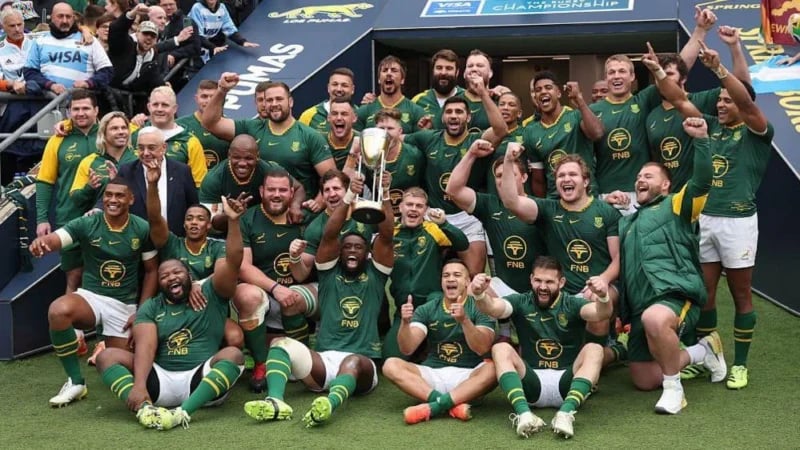
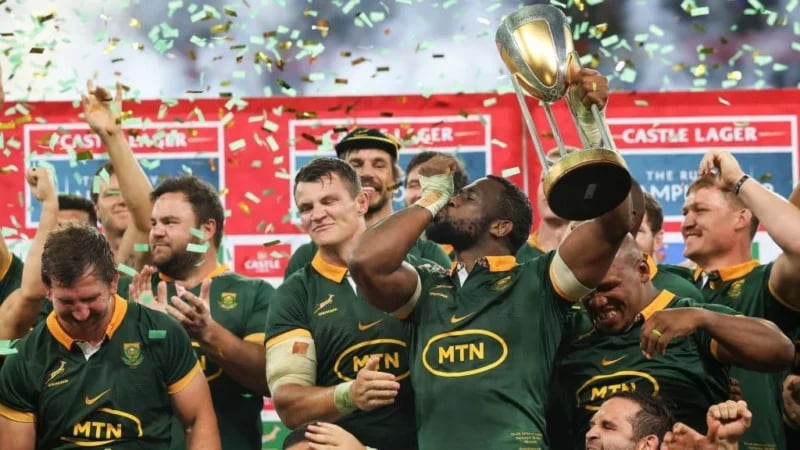
No nation has treated the Rugby World Cup quite like South Africa. The Springboks did not appear at the first two tournaments, then turned up in 1995 and reached the summit at the first attempt. Nearly three decades later, in October 2023, they became the only side to lift the Webb Ellis Cup four times. Their story is not one of steady accumulation but of dramatic peaks: four finals reached, four finals won, with an unmatched habit of settling the biggest matches by the narrowest margins.
This is a reference account of every South African World Cup campaign, the results that defined them, and the records the Boks now hold. Scores and dates below follow the tournament’s official match record.
Absent, then champions: the 1995 breakthrough
South Africa played no part in the inaugural tournaments of 1987 or 1991, excluded by the sporting isolation of the apartheid era. Readmission to international sport arrived in the early 1990s, and the country was awarded hosting rights for 1995, the Springboks’ first World Cup.
What followed is among the most retold stories in the sport. South Africa opened by beating defending champions Australia in Cape Town, advanced through the knockout rounds, and met New Zealand in the final at Ellis Park in Johannesburg. The match finished 15-12 to South Africa after extra time, decided by a Joel Stransky drop goal. Nelson Mandela, wearing a Springbok jersey, presented the trophy to captain Francois Pienaar, an image that reached far beyond rugby. It remains one of only a handful of World Cup finals settled in extra time.
15-121995 final vs New Zealand (a.e.t.)The lean years: 1999 and 2003
Defending the title proved harder. At the 1999 tournament, hosted by Wales, South Africa produced one of the competition’s freak individual performances when fly-half Jannie de Beer struck five drop goals in a quarter-final win over England, a single-match World Cup record that still stands. The Boks then lost a tight semi-final to Australia and beat New Zealand in the third-place play-off, finishing third.
The 2003 edition in Australia was less kind. South Africa topped nothing of note in a difficult pool and went out in the quarter-finals, beaten 29-9 by New Zealand. It was, by the standards the country sets itself, a low point, and it prompted a rebuild under coach Jake White.
Order restored: the 2007 title
White’s side arrived in France in 2007 as one of the tournament favourites and played like it. South Africa handed England a 36-0 defeat in the pool stage, then met the same opponents again in the final at the Stade de France in Paris. The rematch was tighter but never truly in doubt: the Springboks won 15-6, with full-back Percy Montgomery and Francois Steyn supplying the points from the tee. Captain John Smit lifted the second Webb Ellis Cup, and South Africa had confirmed that 1995 was no home-soil fluke.
5drop goals by Jannie de Beer, 1999 QF (World Cup record)Quarter-final exits and a famous upset
The middle of the 2010s brought two campaigns that ended before the final weekend. In 2011, in New Zealand, South Africa lost a bruising quarter-final to Australia by 11-9, undone by kicking and a refereeing performance long debated in the Republic. Four years later, at the 2015 tournament in England, the Boks suffered arguably the greatest shock in World Cup history, beaten 34-32 by Japan in Brighton in their opening pool match. They regrouped to top the group, reached the semi-finals, and lost to New Zealand 20-18. A win over Argentina secured third place.
Kolisi’s era: back-to-back crowns in 2019 and 2023
Rassie Erasmus took charge before the 2019 tournament in Japan and, with Siya Kolisi as captain, oversaw a transformation. South Africa lost their opening pool game to New Zealand but did not lose again. They ground out a semi-final against Wales and then dismantled England 32-12 in the final at Yokohama, tries from Makazole Mapimpi and Cheslin Kolbe adding gloss to Handre Pollard’s boot. Kolisi became the first Black captain to lift the World Cup for South Africa, a milestone that resonated well beyond the touchline.
The 2023 campaign in France was different in character, a test of nerve rather than dominance. South Africa won three consecutive knockout matches by a single point: 29-28 against hosts France in the quarter-final, 16-15 against England in the semi-final, and 12-11 against New Zealand in the final at the Stade de France. Pollard’s goal-kicking proved decisive throughout, and the All Blacks played much of the final a man down after Sam Cane received the first red card in a World Cup final. With that 12-11 win, South Africa became the first four-time world champions and the second nation, after New Zealand, to retain the trophy.
3one-point knockout wins on the way to the 2023 titleThe full record, tournament by tournament
| Year | Host | Result | Decisive match |
|---|---|---|---|
| 1987 | NZ/Australia | Did not participate | Sporting isolation |
| 1991 | UK/Ireland/France | Did not participate | Sporting isolation |
| 1995 | South Africa | Champions | 15-12 v New Zealand (a.e.t.) |
| 1999 | Wales | Third place | Lost semi-final to Australia |
| 2003 | Australia | Quarter-final | 9-29 v New Zealand |
| 2007 | France | Champions | 15-6 v England |
| 2011 | New Zealand | Quarter-final | 9-11 v Australia |
| 2015 | England | Third place | 18-20 v New Zealand (SF) |
| 2019 | Japan | Champions | 32-12 v England |
| 2023 | France | Champions | 12-11 v New Zealand |
What the numbers say
Three statistics frame the Springbok record. First, four titles from ten editions contested, achieved despite missing the first two tournaments entirely. Second, a perfect record in finals: every time South Africa has reached the last match, it has won. Third, an extraordinary tolerance for tight rugby. Their four finals were decided by margins of three, nine, twenty, and one point, and the 2023 run showed a side built to survive knockout pressure rather than avoid it.
The Springboks captaincy lineage tells its own story: Francois Pienaar in 1995, John Smit in 2007, and Siya Kolisi across both 2019 and 2023. Three captains, four trophies, and a nation that has turned the World Cup into the clearest measure of its rugby identity. For a side that arrived late to the competition, South Africa has left a mark no one else has matched.